Posts

links

Penetrant Testing (PT)
Image
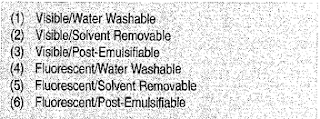
Penetrant Testing (PT) In general terms, penetrant testing reveals surface discontinuities by the bleedout of a penetrating medium against a contrasting colored background. This is accomplished by applying a penetrant (usually liquid) to the cleaned surface of the test piece. Once this penetrant is allowed to remain on the surface for a prescribed time (dwell time), it will be drawn into any surface opening by capillary action. Subsequent removal of excess penetrant and application of a developer draws remaining penetrant from discontinuities.  The resultant indications are shown in high contrast and magnify the presence of the discontinuity so it can be visually interpreted. There are two primary ways in which penetrant materials are grouped: specifically, the type of indication produced, and the method of excess penetrant removal.  The two penetrant indications are visible and fluorescent.  The visible dye (usually red) produces a vivid red indi...
Nondestructive Testing (NDT)

Nondestructive Testing (NDT) One of the purposes of an effective quality control program is to determine the suitability of a given base metal or a weld to perform its intended service. One way to judge that suitability is to subject the base metal or weld to destructive tests which would provide information about the performance of that test object. The major disadvantage of such an approach is that, as the name implies, the test object is destroyed in the process. Therefore, a number of tests have been developed to provide an indication of the acceptability of the test object without rendering it unusable for service. These various tests are referred to as nandestructìve tests, because they permit the nondestructive evaluation (NDE) of the metal or component. Even the destructive testing of a given percentage of parts can be expensive and assumes that the untested parts are of the same quality as those tested. Nondestructive tests yield indirect, yet still valid, results...

Visual Inspection (VT)

Visual Inspection (VT) Since the welding inspector’s responsibilities can be extensive and will occur at various stages of the fabrication sequence, a helpful aid is an “inspection checklist.”  Such a document will help the welding inspector organize the inspection effort and assure each specific task has been performed.  An example of such a listing is shown in Figure Also, the various tools used by the visual welding inspector will be reviewed. While the visual inspection method is characterized as requiring a minimum of tools, there are certain devices which can help the welding inspector perform more easily and effectively.  Figure illustrates some of these tools which might be used by the welding inspector to aid in evaluating welds and weldments. It has been mentioned that the only way in which visual inspection can be considered to effectively evaluate the quality of welds is to apply that inspection at every step of the fabrication process. Unle...

Important Qualities of the Welding Inspector

Image
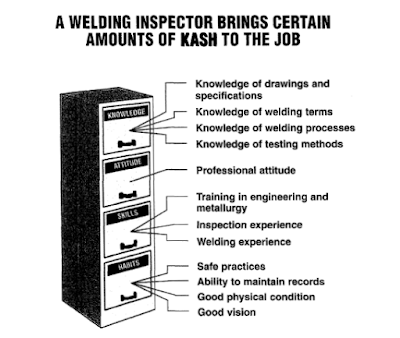
Important Qualities of the Welding Inspector The individual who does welding inspection should possess certain qualities to assure that the job will be done most effectively. Figure 1.2 illustrates these quali ties. The first, and perhaps the most important quality,is a professional attitude. Professional attitude is often the key factor for welding inspector success. Inspector attitude often determines the degree of respect and cooperation received from others during the performance of inspection duties. Included in this category is the ability of the welding inspector to make decisions based on facts so that inspections are fair, impartial and consistent.  If decisions are unfair or show partiality or inconsistency, they greatly affect the inspector’s credibility.  A welding inspector must be completely familiar with the job requirements so that decisions are neither too critical nor too lax.  It is a mistake for the inspector to have preconceive...

Who is the Welding Inspector ?

Who is the Welding Inspector? - Before turning our discussion to the technical subjects, let us talk about the welding inspector as an individual and the typical responsibilities that accompany the position. The welding inspector is a responsible person, involved in the determination of weld quality according to applicable codes and/or specifications. In the performance of inspection tasks, welding inspectors operate in many different circumstances, depending primarily for whom they are working. Thus, there is a special need for job specifications due to the complexity of some components and structures. The inspection workforce may include destructive testing specialists, nondestructive examination (NDE) specialists, code inspectors, military or government inspectors, owner representatives, in-house inspectors, and others.  These individuals may, at times, consider themselves “welding inspectors,”since they inspect welds as part of their job responsibility. The three...

Gas welding using gas filler rod

Image
Gas welding using gas filler rod

How Arc Welding Works

Image
How Arc Welding Works

Ads