Posts

links

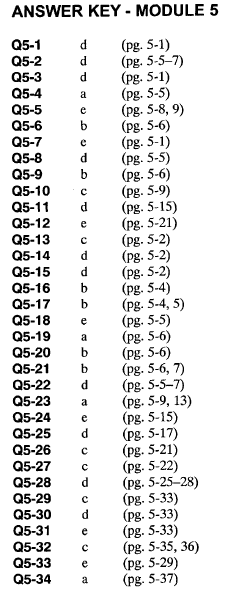
VT - Test ANSWER KEY - MODULE 6

Image
ANSWER KEY-MODULE 6

WELDING INSPECTION TECHNOLOGY WORKBOOK - MODULE 6

VT Test -  MODULE 6 For conversion Factors, refer to “Conversion Chart for Common Welding Terms” on page 10-9 of the workbook and for Formulae refer to page 10-8. Q6-1 The property of metals that describes their resistance to indentation is called: a. strength b. toughness c. hardness d. ductility e. none of the above Q6-2 The property of metals that describes their ability to carry a load is: a. strength b. toughness c. hardness d. ductility e. none of the above Q6-3 Generally, as strength increases for carbon steels, the ductility: a. increases b. stays the same c. decreases d. is not related to strength e. none of the above Q6-4 The property that describes the ability of a metal to deform when stressed is: a. strength b. toughness c. hardness d. ductility e. none of the above Q6-5 The type of strength related to a metal’s behavior when the load is applied in a cyclic manner is: a. tensil...
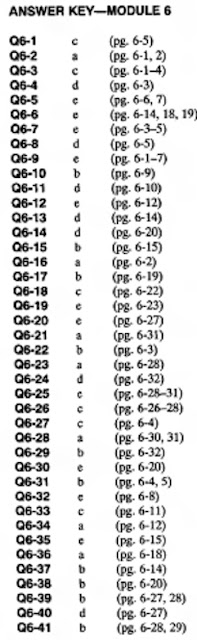
VT - Test ANSWER KEY - MODULE 5

Image
ANSWER KEY-MODULE 5

WELDING INSPECTION TECHNOLOGY WORKBOOK - MODULE 5

VT Test -  MODULE 5 Q5-1 Which of the following do not contain job quality requirements? a. codes b. drawings c. specifications d. textbooks e. Standards Q5-2 Of the following, which may be considered mandatory? a. codes b. specifications c. standards d. all of the above e. none of the above Q5-3 The job documents that best describe the size and configuration of a weldment are: a. codes b. standards c. specifications d. drawings e. none of the above Q5-4  The type of document that has legal status by definition is: a. code b. standard c. specification d. both a and b above e. all of the above Q5-5 The type of document that describes the requirements for a particular material or component is referred to as: a. code b. standard c. specification d. a and b above e. b and c above Q5-6 Something set up and established by authority as a rule to measure quantity, quali...

VT - Test ANSWER KEY - MODULE 4

Image
ANSWER KEY-MODULE 4

WELDING INSPECTION TECHNOLOGY WORKBOOK - MODULE 4

Image
VT Test -  MODULE 4 Q4-1 Which of the following is not considered a type of joint? a. butt b. T c. fillet d. corner e. edge Q4-2 The term for the type of joint formed when the two pieces to be joined lie in parallel planes and their edges overlap is: a. corner b. T c. edge d. lap e. butt Q4-3 The term for that portion of a single bevel butt joint where the two pieces to be joined come closest together is: a. radius b. joint root c. bevel angle d. groove angle e. none of the above Q4-4 In a single V-groove weld, the term for the sloped surfaces against which the weld metal is applied is: a. root face b. root c. groove faces d. groove angle e. bevel angle Q4-5 The term for the type of weld produced by filling an elongated hole in an overlapping member attaching it to the member beneath is: a. plug weld b. spot weld c. seam weld d. slot weld e. none of the above Q4-6 The term for the type of weld configuration formed...

Ads